Plant guide · Algae and cyanobacteria
Cyanobacteria (blue-green algae) (cyanobacteria (several genera))
Cyanobacteria are bacteria, not true algae, though everyone calls them blue-green algae. When they bloom they can make toxins that sicken people, dogs and other animals.
Also called: harmful algal bloom, HAB, blue-green algae
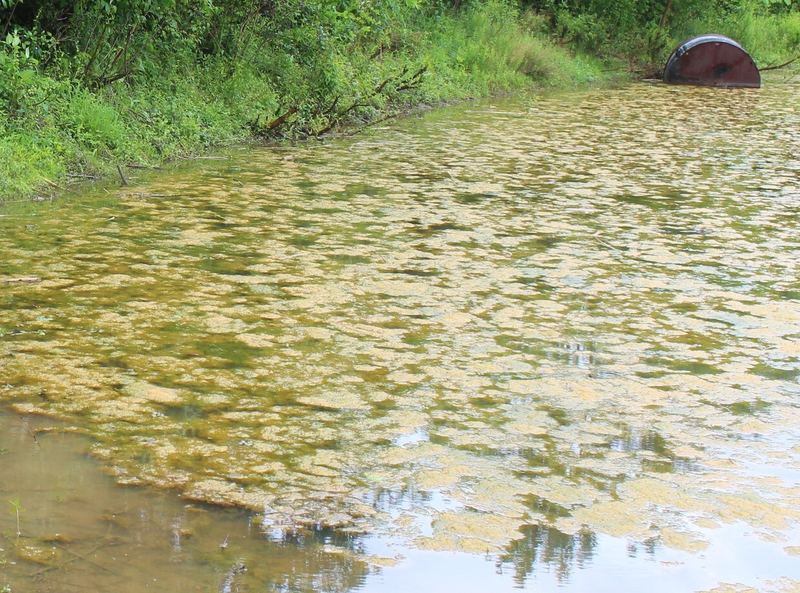

Some blooms are toxic. Keep people and pets out of discoloured or scummy water and report suspected harmful algal blooms (see fact).
What it looks like
- Tiny particles, pinhead-sized or smaller, rather than strands or leaves.
- A surface scum that looks like spilled paint or pea soup, or streaks that look like grass clippings.
- Water that is unusually bright green, blue-green, gray, white or milky; scum often piles up along the shoreline.
- A jar test gives a clue: in a clear jar left undisturbed, many cyanobacteria float to the top while most algae and sediment sink. It cannot tell you whether a bloom is toxic.
Easily confused with
- Filamentous algae: long, stringy mats you can lift out with a stick.
- Duckweed and watermeal: tiny plants with leaves (duckweed also has rootlets).
- Anything firmly attached to rocks, plants or the bottom is unlikely to be cyanobacteria.
Good and bad for your pond
- Cyanobacteria occur naturally in ponds and lakes and are usually harmless at low levels.
- Blooms can produce toxins, cause bad tastes and odors, and use up oxygen as they die, sometimes killing fish.
Native or invasive?
Bacteria, natural at low levels. Blooms are driven by nutrients, warm temperatures, sunlight and calm water, and are most common from mid-June to early September.
Do grass carp eat it?
Not on PFBC's grass carp list
Not a grass carp food (not on PFBC's list).
Control options
Prevention first
Penn State Extension's advice for every nuisance plant and algae problem starts with nutrients: overgrowth is a symptom of excess phosphorus and nitrogen from sources such as barnyards, crop fields, septic systems, lawns and golf courses. Cutting fertilizer near the pond, maintaining septic systems, diverting nutrient-rich runoff and keeping a vegetated buffer strip are the long-term fixes; without them, control becomes a yearly chore. Penn State adds pet waste, failing septic systems and phosphorus stored in pond sediment to the list of sources.
Checked Oct 4, 2026 · Source: Filamentous Algae (updated May 19, 2025) and the companion Penn State plant fact sheets This may be outdated
Remove it by hand or machine
Don't wade in or handle a suspected bloom. Keep children and pets away until it's gone.
Biological options
None recommended while a bloom is active.
Chemical options (permit first)
Penn State notes cyanobacteria can be treated like other algae, but the first step is to stay out of the water. Any herbicide or algaecide in a pond needs a joint DEP/PFBC Chapter 91 permit first, at any amount.
Checked Oct 4, 2026 · Source: Water Quality Permitting for Pesticide Applications in Pennsylvania: FAQ (rev. Feb 21, 2025), FAQ #2, #3, #8, #10, #11, #28, #29 This may be outdated
Follow the product label; the label is the law. A Chapter 91 permit is required before any herbicide or algaecide goes in a pond (see fact). Consider a licensed applicator.
Report it
Harmful algal blooms are caused by cyanobacteria ("blue-green algae") and can produce toxins that harm people, pets and other animals. If you suspect one, keep people and pets out of the water and do not swallow or breathe in spray from it. Only a laboratory test can confirm a bloom. Report a suspected bloom to the Pennsylvania HABs Task Force (HABs@pa.gov). Blooms are most common from mid-June to early September.
Checked Oct 4, 2026 · Source: Harmful Algal Blooms (HABs hub) This may be outdated
PFBC: Report aquatic invasive species PA iMapInvasives
Sources
- Harmful Algal Blooms (Pennsylvania Department of Environmental Protection)
- What's That Green Stuff? How to Identify Harmful Algal Blooms (Penn State Extension)
- Harmful Algae Blooms (HABs) (Penn State Extension)
- Controlling Nuisance Aquatic Plants and Algae in Farm Ponds (Penn State Extension)
- Protecting Dogs and Animals from Harmful Algae Blooms (Penn State Extension)
Checked Oct 4, 2026