Plant guide · Submerged plants
Elodea (Elodea canadensis)
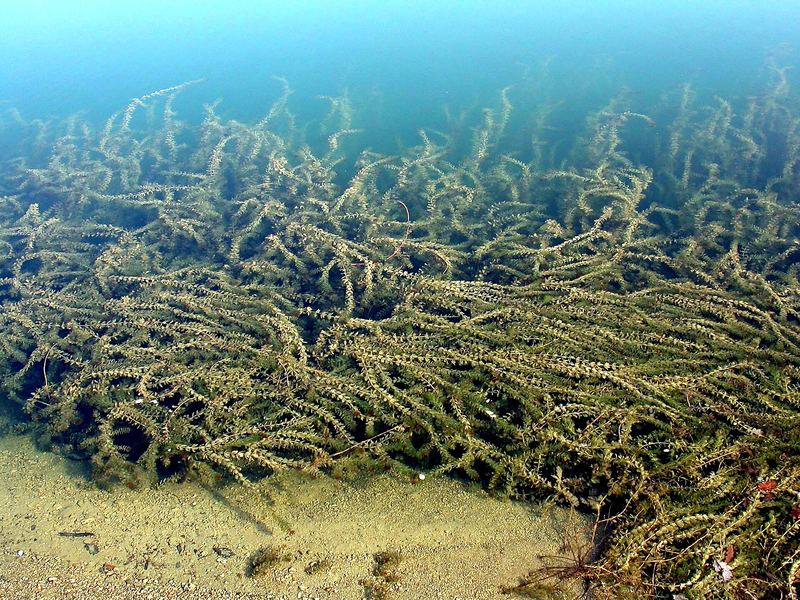
A native submerged plant with small dark-green leaves in whorls of two or three, crowded toward the tips. One of the few pond plants that stays green all winter.
Also called: common waterweed, Canadian waterweed

What it looks like
- Dark-green leaves in dense whorls of two or three, more crowded toward the top of the stem.
- Leaf edges have tiny teeth you may only see with a magnifier.
- Likes fine sediment in cool, spring-fed ponds; stays green through winter.
- Spreads mainly from broken stem pieces.
Easily confused with
- Hydrilla (invasive): leaves usually in whorls of five, with obvious teeth. If you suspect hydrilla, report it.
- Coontail: stiff, forked leaves bunched at the tips.
Good and bad for your pond
- Cover for insects and fish, food for wildlife, and underwater habitat in winter; modest amounts are good for a pond.
- Dense growth gets in the way of boating and fishing and can lower summer oxygen enough to kill fish.
Native or invasive?
Native
Native. Native to most of North America (Penn State; USDA PLANTS).
USDA PLANTS: ELCA7 (lower 48 states: native)
Do grass carp eat it?
Grass carp eat it
One of grass carp's preferred foods; Penn State calls grass carp an excellent option for elodea. Grass carp prefer submerged plants like pondweeds, elodea and coontail; they rarely control algae mats or lilies.
Checked Oct 4, 2026 · Source: Using Grass Carp to Control Aquatic Plants (updated May 19, 2025) This may be outdated
Control options
Prevention first
Penn State Extension's advice for every nuisance plant and algae problem starts with nutrients: overgrowth is a symptom of excess phosphorus and nitrogen from sources such as barnyards, crop fields, septic systems, lawns and golf courses. Cutting fertilizer near the pond, maintaining septic systems, diverting nutrient-rich runoff and keeping a vegetated buffer strip are the long-term fixes; without them, control becomes a yearly chore.
Checked Oct 4, 2026 · Source: Filamentous Algae (updated May 19, 2025) and the companion Penn State plant fact sheets This may be outdated
Remove it by hand or machine
Cutting or raking isn't recommended because fragments regrow. A winter drawdown can freeze the roots: Over 1 acre (or with another state permit): PFBC drawdown permit, 30+ days ahead, no fee.
Checked Oct 4, 2026 · Source: Apply to Draw Off Water from Impoundments This may be outdated
Biological options
Grass carp, with a PFBC permit: PFBC grass carp permit needed for each waterbody before buying or stocking; $85 fee, returned if denied.
Checked Oct 4, 2026 · Source: 58 Pa. Code § 71a.10, Triploid grass carp This may be outdated
Chemical options (permit first)
Often needed every year if nutrients aren't addressed. Any herbicide or algaecide in a pond needs a joint DEP/PFBC Chapter 91 permit first, at any amount. Only products registered with the U.S. Environmental Protection Agency and with the Pennsylvania Department of Agriculture, and labeled specifically for aquatic use, can be listed on the Chapter 91 permit application. Treat in sections, early in the season: decaying plants can strip oxygen and kill fish.
Checked Oct 4, 2026 · Sources: Water Quality Permitting for Pesticide Applications in Pennsylvania: FAQ (rev. Feb 21, 2025), FAQ #2, #3, #8, #10, #11, #28, #29; Permit Requirement for Use of an Aquatic Herbicide in Ponds (updated Sep 8, 2025); Pond Management (FAQ: controlling submerged vegetation) This may be outdated
Follow the product label; the label is the law. A Chapter 91 permit is required before any herbicide or algaecide goes in a pond (see fact). Consider a licensed applicator.
Sources
- Elodea (Common Waterweed) (Penn State Extension)
- DCNR invasive plant fact sheet: Hydrilla (Pennsylvania Department of Conservation and Natural Resources)
- USDA PLANTS Database (species profiles: https://plants.usda.gov/plant-profile/<SYMBOL>) (USDA Natural Resources Conservation Service)
Checked Oct 4, 2026