Plant guide · Algae and cyanobacteria
Filamentous algae (many species)
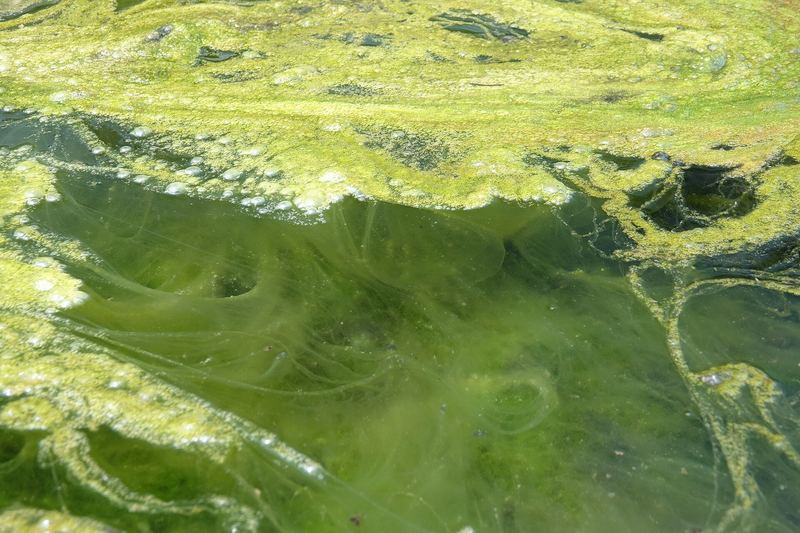
The stringy green "moss" that starts on the bottom in spring and floats up as slimy mats by mid-summer. It is the most common algae complaint from Pennsylvania pond owners.
Also called: pond scum, pond moss

Some blooms are toxic. Keep people and pets out of discoloured or scummy water and report suspected harmful algal blooms (see fact).
What it looks like
- Hair-like green strands or clumps with no leaves, roots or stems.
- Starts on the bottom in shallow water, then traps gas bubbles and floats to the surface as mats.
- Mats usually show up in July and can cover a pond by late summer.
- You can lift a mat out of the water with a stick or rake.
Easily confused with
- Cyanobacteria (blue-green algae): tiny specks, paint-like streaks or a pea-soup look, not strands you can lift. See the cyanobacteria page.
- Duckweed and watermeal: tiny floating leaves, not strands.
Good and bad for your pond
- All algae feed insects, tiny animals and, in turn, fish; some is always present.
- Heavy mats spoil swimming and fishing, and dying algae can use up oxygen and kill fish in late summer and fall.
Native or invasive?
Algae: a natural part of every pond. Algae are a normal part of the pond food web. Problems come from too much of it, which almost always means too many nutrients.
Do grass carp eat it?
Grass carp usually leave it alone
Not a grass carp food. PFBC lists filamentous algae among the plants grass carp usually don't control, and Penn State says grass carp aren't a recommended control for it. Grass carp prefer submerged plants like pondweeds, elodea and coontail; they rarely control algae mats or lilies.
Checked Oct 4, 2026 · Source: Using Grass Carp to Control Aquatic Plants (updated May 19, 2025) This may be outdated
Control options
Prevention first
Penn State Extension's advice for every nuisance plant and algae problem starts with nutrients: overgrowth is a symptom of excess phosphorus and nitrogen from sources such as barnyards, crop fields, septic systems, lawns and golf courses. Cutting fertilizer near the pond, maintaining septic systems, diverting nutrient-rich runoff and keeping a vegetated buffer strip are the long-term fixes; without them, control becomes a yearly chore.
Checked Oct 4, 2026 · Source: Filamentous Algae (updated May 19, 2025) and the companion Penn State plant fact sheets This may be outdated
Remove it by hand or machine
Net or rake the mats off and pile them well away from the water so the nutrients don't wash back in. This is hard work but very effective on small ponds, and it removes nutrients. Aeration helps more with planktonic algae than with mats.
Biological options
PFBC says using barley straw to discourage algae is not regulated by permit. It works by preventing new algae growth rather than killing existing algae, and too much straw can use up oxygen as it decays. Penn State and PFBC give different amounts per acre, so follow one source's guidance and start small. Bacteria and enzyme additives have given inconsistent results; Alum used against algae needs the Chapter 91 permit; ask DEP about enzyme products.
Checked Oct 4, 2026 · Sources: Pond Management (FAQ: How can I control algae?); Water Quality Permitting for Pesticide Applications in Pennsylvania: FAQ (rev. Feb 21, 2025), FAQ #23 and #24 This may be outdated
Chemical options (permit first)
Any herbicide or algaecide in a pond needs a joint DEP/PFBC Chapter 91 permit first, at any amount. Only products registered with the U.S. Environmental Protection Agency and with the Pennsylvania Department of Agriculture, and labeled specifically for aquatic use, can be listed on the Chapter 91 permit application. Penn State cautions that copper-based algaecides can be toxic to some fish, including trout and grass carp; read the label. Treat in sections, early in the season: decaying plants can strip oxygen and kill fish.
Checked Oct 4, 2026 · Sources: Water Quality Permitting for Pesticide Applications in Pennsylvania: FAQ (rev. Feb 21, 2025), FAQ #2, #3, #8, #10, #11, #28, #29; Permit Requirement for Use of an Aquatic Herbicide in Ponds (updated Sep 8, 2025); Pond Management (FAQ: controlling submerged vegetation) This may be outdated
Follow the product label; the label is the law. A Chapter 91 permit is required before any herbicide or algaecide goes in a pond (see fact). Consider a licensed applicator.
Sources
- Filamentous Algae (Penn State Extension)
- Controlling Nuisance Aquatic Plants and Algae in Farm Ponds (Penn State Extension)
- Pond Management (Pennsylvania Fish and Boat Commission)
- What's That Green Stuff? How to Identify Harmful Algal Blooms (Penn State Extension)
- Pond Owner's Guide to the Use of Triploid Grass Carp in Pennsylvania (6-12) (Pennsylvania Fish and Boat Commission (copy hosted by Susquehanna County Conservation District))
Checked Oct 4, 2026