Plant guide · Submerged plants
Hydrilla (Hydrilla verticillata)
One of the most damaging aquatic invaders in the country, and on Pennsylvania's noxious weed list. If you think you have it, report it before you do anything else.
Also called: waterthyme
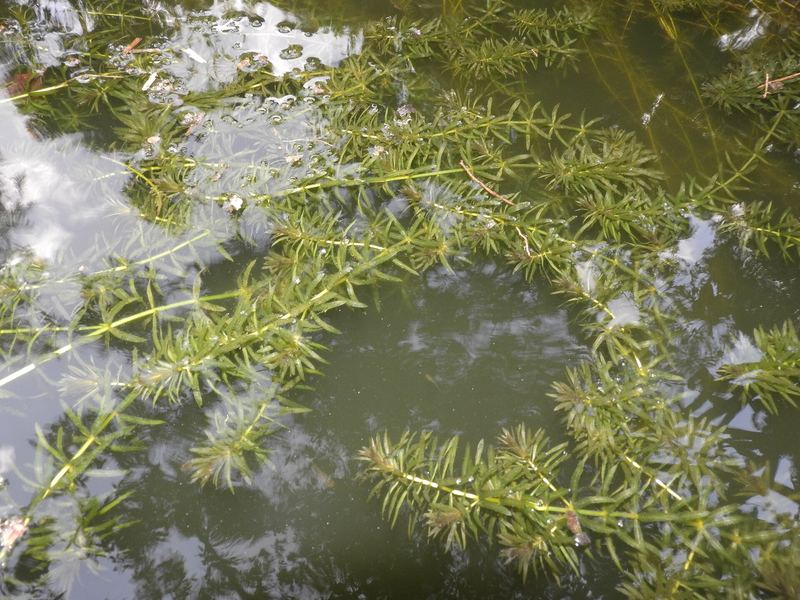

What it looks like
- A rooted underwater plant with long trailing stems.
- Leaves in whorls, usually five (DCNR says three to eight), with toothed edges and small raised teeth on the undersides.
- Leaf midribs are often reddish.
- Forms small tubers on the roots and overwintering buds (turions), which let it regrow after treatment.
Easily confused with
- Elodea (native): leaves in whorls of two or three, with teeth too small to see without a magnifier.
Good and bad for your pond
- Forms dense mats that crowd out native plants, hamper recreation and slow water flow.
- Spreads from tiny fragments, tubers and turions, often on boats, gear and water-garden plants.
Native or invasive?
Pennsylvania noxious weed
Invasive; Pennsylvania noxious weed. Class B noxious weed in Pennsylvania (PDA), listed by DCNR as a severe threat (DCNR's fact sheet also notes it is a federal noxious weed), and one of PFBC's 'least-wanted' aquatic invaders; introduced (USDA PLANTS).
USDA PLANTS: HYVE3 (lower 48 states: introduced)
Noxious weeds (e.g. water chestnut, hydrilla, Eurasian watermilfoil) may not be sold, moved or planted in PA.
Checked Oct 4, 2026 · Source: Controlled Plant & Noxious Weed Lists This may be outdated
Do grass carp eat it?
Not on PFBC's grass carp list
Not on PFBC's grass carp list. Report hydrilla instead of trying to fix it yourself.
Control options
Prevention first
Noxious weeds (e.g. water chestnut, hydrilla, Eurasian watermilfoil) may not be sold, moved or planted in PA. Check boats, trailers and water-garden plants for fragments.
Checked Oct 4, 2026 · Source: Controlled Plant & Noxious Weed Lists This may be outdated
Remove it by hand or machine
Don't pull or cut it: fragments spread it. DCNR says monitoring and prevention matter most.
Biological options
None to try on your own.
Chemical options (permit first)
Once it is confirmed, follow the agencies' advice on treatment. Any herbicide or algaecide in a pond needs a joint DEP/PFBC Chapter 91 permit first, at any amount.
Checked Oct 4, 2026 · Source: Water Quality Permitting for Pesticide Applications in Pennsylvania: FAQ (rev. Feb 21, 2025), FAQ #2, #3, #8, #10, #11, #28, #29 This may be outdated
Follow the product label; the label is the law. A Chapter 91 permit is required before any herbicide or algaecide goes in a pond (see fact). Consider a licensed applicator.
Report it
Report a suspected aquatic invasive species, such as hydrilla or European water chestnut, to the Pennsylvania Fish and Boat Commission with its online form or the Pennsylvania Invasive Species Reporting hotline (1-833-INVASIV), or through PA iMapInvasives. A photo and the exact location help staff confirm it.
Checked Oct 4, 2026 · Source: Report Aquatic Invasive Species (AIS) This may be outdated
PFBC: Report aquatic invasive species PA iMapInvasives
Sources
- DCNR invasive plant fact sheet: Hydrilla (Pennsylvania Department of Conservation and Natural Resources)
- Aquatic Invasive Species in Pennsylvania (Penn State Extension)
- Controlled Plant and Noxious Weed Lists (Pennsylvania Department of Agriculture)
- Aquatic Invasive Species (Pennsylvania Fish and Boat Commission)
- Report Aquatic Invasive Species (Pennsylvania Fish and Boat Commission)
- USDA PLANTS Database (species profiles: https://plants.usda.gov/plant-profile/<SYMBOL>) (USDA Natural Resources Conservation Service)
- DCNR Invasive Plant Species List (Pennsylvania Department of Conservation and Natural Resources)
Checked Oct 4, 2026