Plant guide · Shoreline (emergent) plants
Phragmites (common reed) (Phragmites australis)
A very tall reed grass with feathery plumes that can take over shorelines and wetlands. The aggressive form is a non-native strain; a native form also exists and looks very similar.
Also called: common reed
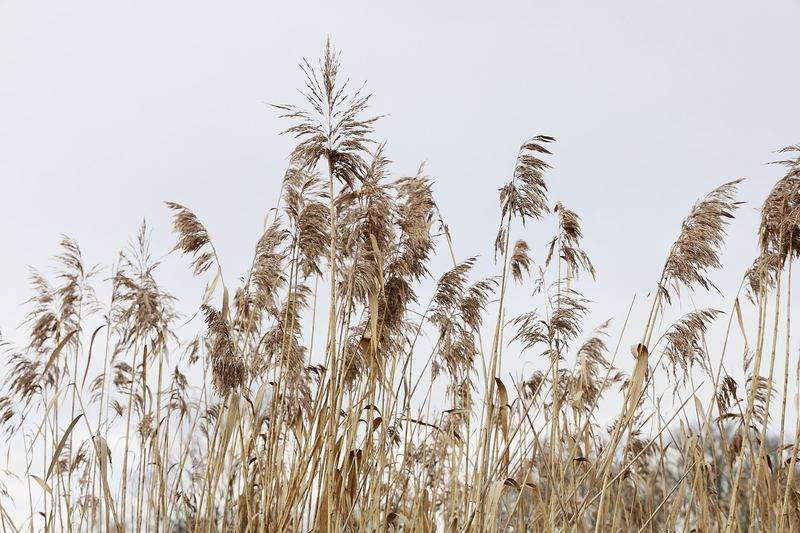

What it looks like
- A tall perennial grass that can reach about fifteen feet.
- Long leaves with rough edges.
- Feathery purple or golden flower plumes in late July and August.
- Dense stands with last year's dead stems still standing among the new ones.
Easily confused with
- The native subspecies of common reed (very similar).
- Reed canary grass and wild rice (DCNR).
Good and bad for your pond
- DCNR says the non-native strain crowds out native plants, changes water flow and wildlife habitat and raises fire risk.
- PFBC notes it invades wetlands and reduces their value to wildlife.
Native or invasive?
Invasive in Pennsylvania
Invasive (non-native strain). The non-native strain (Phragmites australis ssp. australis) is a severe-threat invasive on DCNR's list. A native subspecies also grows in North America (DCNR; USDA PLANTS lists both).
USDA PLANTS: PHAU7 (lower 48 states: introduced and native)
Do grass carp eat it?
Not on PFBC's grass carp list
Not on PFBC's grass carp list.
Control options
Prevention first
Clean mowers and equipment after working in a stand; rhizome pieces spread it (DCNR).
Remove it by hand or machine
DCNR says a small patch can be dug out by hand if you remove the whole rhizome system and every new sprout, and bag all of it. Larger stands need a plan and years of follow-up for resprouts and seedlings.
Biological options
None.
Chemical options (permit first)
DEP counts wetlands, including seasonal ones, as surface waters, so treating plants standing in a wetland or in water needs this permit too. Only products registered with the U.S. Environmental Protection Agency and with the Pennsylvania Department of Agriculture, and labeled specifically for aquatic use, can be listed on the Chapter 91 permit application.
Checked Oct 4, 2026 · Sources: Water Quality Permitting for Pesticide Applications in Pennsylvania: FAQ (rev. Feb 21, 2025), FAQ #2, #3, #8, #10, #11, #28, #29; Permit Requirement for Use of an Aquatic Herbicide in Ponds (updated Sep 8, 2025) This may be outdated
Follow the product label; the label is the law. A Chapter 91 permit is required before any herbicide or algaecide goes in a pond (see fact). Consider a licensed applicator.
Report it
Report a suspected aquatic invasive species, such as hydrilla or European water chestnut, to the Pennsylvania Fish and Boat Commission with its online form or the Pennsylvania Invasive Species Reporting hotline (1-833-INVASIV), or through PA iMapInvasives. A photo and the exact location help staff confirm it.
Checked Oct 4, 2026 · Source: Report Aquatic Invasive Species (AIS) This may be outdated
PFBC: Report aquatic invasive species PA iMapInvasives
Sources
- DCNR invasive plant fact sheet: Common reed (Phragmites) (Pennsylvania Department of Conservation and Natural Resources)
- DCNR Invasive Plant Species List (Pennsylvania Department of Conservation and Natural Resources)
- Pond Management (Pennsylvania Fish and Boat Commission)
- USDA PLANTS Database (species profiles: https://plants.usda.gov/plant-profile/<SYMBOL>) (USDA Natural Resources Conservation Service)
Checked Oct 4, 2026