Plant guide · Algae and cyanobacteria
Planktonic algae (many microscopic species)
Microscopic algae floating in the water itself. A bloom can tint a pond green, brown or reddish within a day or two and often clears just as fast in fall.
Also called: green water, algae bloom
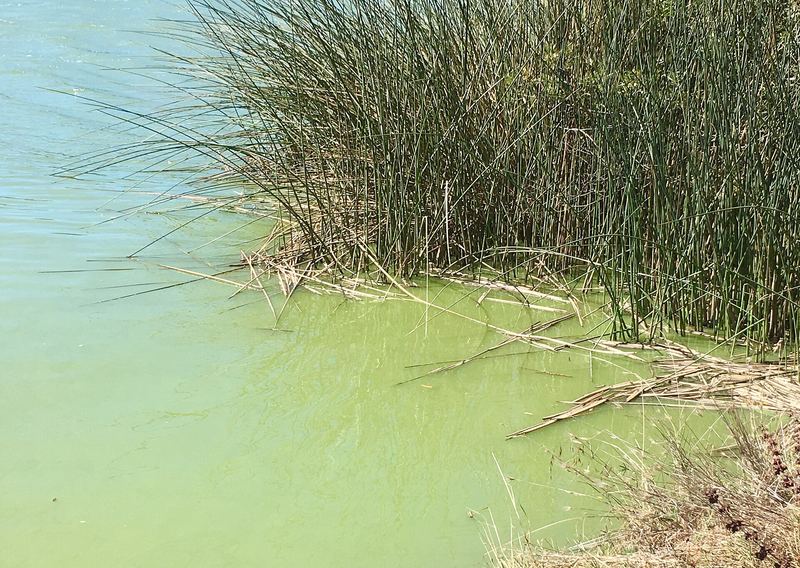

Some blooms are toxic. Keep people and pets out of discoloured or scummy water and report suspected harmful algal blooms (see fact).
What it looks like
- No strands or leaves: the water itself looks green, brown or reddish.
- Can look like muddy water at first glance.
- Blooms can color the water within a day or two when conditions are right.
- Typically clear in winter, cloudy in summer; blooms often crash around the first frost and the pond clears almost overnight.
Easily confused with
- Muddy water from runoff or bottom-feeding fish.
- A harmful cyanobacteria bloom: you can't tell them apart by eye, and only a lab test confirms one. Treat unusually bright, paint-like or scummy water as suspect.
Good and bad for your pond
- Planktonic algae are the base of the pond food chain; ponds with plenty of it can support more, faster-growing fish.
- Too much clouds the water, and a sudden die-off in late summer or fall can drop oxygen and cause a fish kill.
Native or invasive?
Algae: a natural part of every pond. A normal part of every pond. Big blooms are a nutrient problem.
Do grass carp eat it?
Not on PFBC's grass carp list
Not on PFBC's grass carp list. Penn State says no fish eat enough planktonic algae to control it.
Control options
Prevention first
Penn State Extension's advice for every nuisance plant and algae problem starts with nutrients: overgrowth is a symptom of excess phosphorus and nitrogen from sources such as barnyards, crop fields, septic systems, lawns and golf courses. Cutting fertilizer near the pond, maintaining septic systems, diverting nutrient-rich runoff and keeping a vegetated buffer strip are the long-term fixes; without them, control becomes a yearly chore. Penn State notes that aeration may reduce planktonic algae growth in summer.
Checked Oct 4, 2026 · Source: Filamentous Algae (updated May 19, 2025) and the companion Penn State plant fact sheets This may be outdated
Remove it by hand or machine
The cells are too small to net, rake or skim.
Biological options
Bacteria and enzyme products are sold for this; Penn State reports they can work but are pricey. Alum used against algae needs the Chapter 91 permit; ask DEP about enzyme products.
Checked Oct 4, 2026 · Source: Water Quality Permitting for Pesticide Applications in Pennsylvania: FAQ (rev. Feb 21, 2025), FAQ #23 and #24 This may be outdated
Chemical options (permit first)
Any herbicide or algaecide in a pond needs a joint DEP/PFBC Chapter 91 permit first, at any amount. Only products registered with the U.S. Environmental Protection Agency and with the Pennsylvania Department of Agriculture, and labeled specifically for aquatic use, can be listed on the Chapter 91 permit application. Treat in sections, early in the season: decaying plants can strip oxygen and kill fish. Thinking about a dye instead? Dyes that control algae need the Chapter 91 permit; color-only dyes are limited in flow-through ponds.
Checked Oct 4, 2026 · Sources: Water Quality Permitting for Pesticide Applications in Pennsylvania: FAQ (rev. Feb 21, 2025), FAQ #25; Permit Requirement for Use of an Aquatic Herbicide in Ponds (updated Sep 8, 2025); Pond Management (FAQ: controlling submerged vegetation) This may be outdated
Follow the product label; the label is the law. A Chapter 91 permit is required before any herbicide or algaecide goes in a pond (see fact). Consider a licensed applicator.
Sources
- Planktonic Algae (Penn State Extension)
- Controlling Nuisance Aquatic Plants and Algae in Farm Ponds (Penn State Extension)
- Harmful Algal Blooms (Pennsylvania Department of Environmental Protection)
- Water Quality Permitting for Pesticide Applications: Frequently Asked Questions (Pennsylvania Department of Environmental Protection)
Checked Oct 4, 2026