Plant guide · Shoreline (emergent) plants
Purple loosestrife (Lythrum salicaria)
A tall, pretty, magenta-flowered shoreline plant that is a Pennsylvania noxious weed. It forms dense stands that push out native wetland plants.
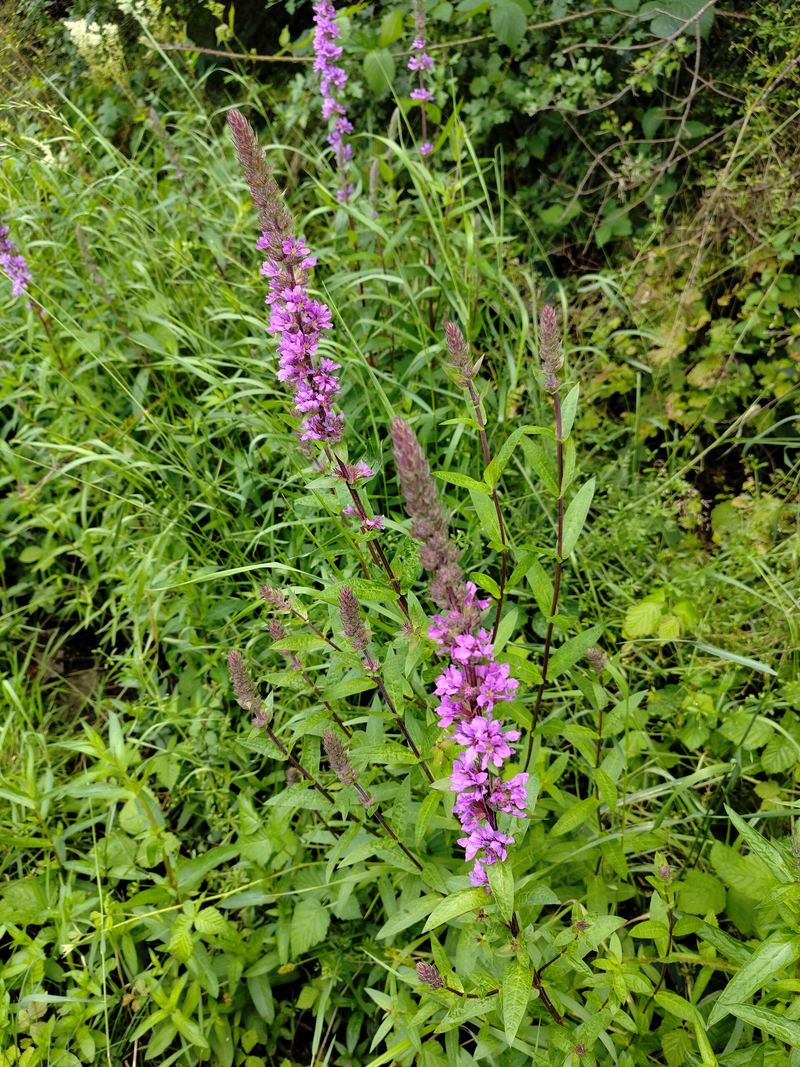

What it looks like
- Square, woody stems, from about four to ten feet tall.
- Lance-shaped leaves in pairs or whorls.
- Magenta to purple flower spikes from June into September.
Easily confused with
- Native plants with purple flower spikes, such as pickerelweed (violet-blue spikes).
Good and bad for your pond
- Little value to birds, mammals or waterfowl.
- Forms dense single-species stands in wetlands and along shores; one plant can produce millions of seeds.
Native or invasive?
Pennsylvania noxious weed
Pennsylvania noxious weed. Class B noxious weed in Pennsylvania, including its cultivars (PDA), and a severe-threat invasive on DCNR's list; introduced (USDA PLANTS).
USDA PLANTS: LYSA2 (lower 48 states: introduced)
Noxious weeds (e.g. water chestnut, hydrilla, Eurasian watermilfoil) may not be sold, moved or planted in PA.
Checked Oct 4, 2026 · Source: Controlled Plant & Noxious Weed Lists This may be outdated
Do grass carp eat it?
Not on PFBC's grass carp list
Not on PFBC's grass carp list.
Control options
Prevention first
Noxious weeds (e.g. water chestnut, hydrilla, Eurasian watermilfoil) may not be sold, moved or planted in PA. Don't plant it: even cultivars sold as sterile can cross with wild plants and make seed.
Checked Oct 4, 2026 · Source: Controlled Plant & Noxious Weed Lists This may be outdated
Remove it by hand or machine
Pull young plants; dig out older ones with all of the roots, since root pieces resprout. Cutting stems makes it resprout. During flowering, cut off the flower heads, bag them and destroy them to stop seed.
Biological options
None to try on your own.
Chemical options (permit first)
DEP counts wetlands, including seasonal ones, as surface waters, so treating plants standing in a wetland or in water needs this permit too. Only products registered with the U.S. Environmental Protection Agency and with the Pennsylvania Department of Agriculture, and labeled specifically for aquatic use, can be listed on the Chapter 91 permit application.
Checked Oct 4, 2026 · Sources: Water Quality Permitting for Pesticide Applications in Pennsylvania: FAQ (rev. Feb 21, 2025), FAQ #2, #3, #8, #10, #11, #28, #29; Permit Requirement for Use of an Aquatic Herbicide in Ponds (updated Sep 8, 2025) This may be outdated
Follow the product label; the label is the law. A Chapter 91 permit is required before any herbicide or algaecide goes in a pond (see fact). Consider a licensed applicator.
Report it
Report a suspected aquatic invasive species, such as hydrilla or European water chestnut, to the Pennsylvania Fish and Boat Commission with its online form or the Pennsylvania Invasive Species Reporting hotline (1-833-INVASIV), or through PA iMapInvasives. A photo and the exact location help staff confirm it.
Checked Oct 4, 2026 · Source: Report Aquatic Invasive Species (AIS) This may be outdated
PFBC: Report aquatic invasive species PA iMapInvasives
Sources
- Purple Loosestrife: A Noxious Weed (Penn State Extension)
- DCNR invasive plant fact sheet: Purple loosestrife (Pennsylvania Department of Conservation and Natural Resources)
- Controlled Plant and Noxious Weed Lists (Pennsylvania Department of Agriculture)
- DCNR Invasive Plant Species List (Pennsylvania Department of Conservation and Natural Resources)
- Controlling Nuisance Aquatic Plants and Algae in Farm Ponds (Penn State Extension)
- USDA PLANTS Database (species profiles: https://plants.usda.gov/plant-profile/<SYMBOL>) (USDA Natural Resources Conservation Service)
Checked Oct 4, 2026