Plant guide · Floating plants
European water chestnut (Trapa natans)
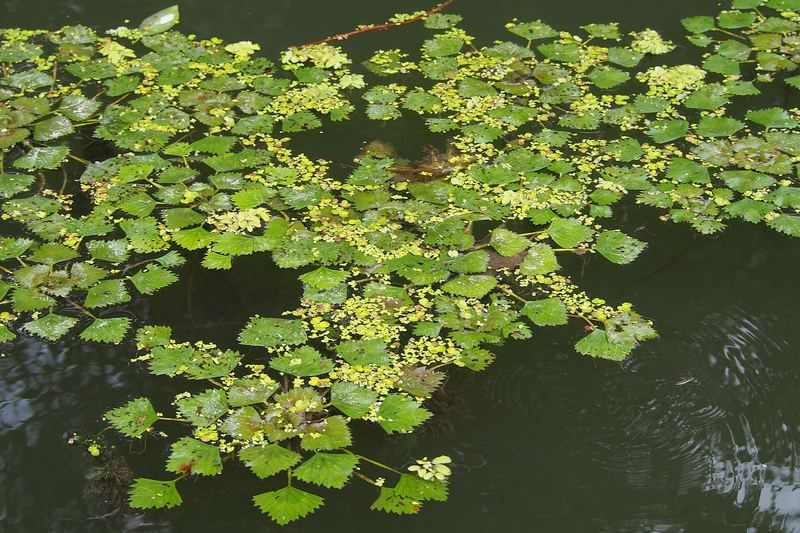
An invasive annual that forms floating rosettes of glossy, toothed, triangular leaves and drops sharp four-spined nuts. It is spreading in Pennsylvania and is on the state's noxious weed list.
Also called: water chestnut

What it looks like
- Floating rosettes of glossy, roughly triangular leaves with toothed edges.
- Feathery leaves underwater along a long, cord-like stem.
- Small white four-petalled flowers in the center of the rosette from mid to late July.
- Hard nuts with four sharp spines, ripening about a month after flowering; spines can puncture shoes.
Easily confused with
- Penn State says no other aquatic plant is a real look-alike.
Good and bad for your pond
- Little food value for wildlife compared with native plants.
- Dense mats choke ponds, block light, lower oxygen and make fishing, boating and swimming nearly impossible.
- Seeds can stay viable for many years, so an infestation takes years to clear.
Native or invasive?
Pennsylvania noxious weed
Invasive; Pennsylvania noxious weed. Class A noxious weed in Pennsylvania (PDA) and a severe-threat invasive on DCNR's list; introduced to North America (USDA PLANTS). Penn State reports its Pennsylvania range is expanding.
USDA PLANTS: TRNA (lower 48 states: introduced)
Noxious weeds (e.g. water chestnut, hydrilla, Eurasian watermilfoil) may not be sold, moved or planted in PA.
Checked Oct 4, 2026 · Source: Controlled Plant & Noxious Weed Lists This may be outdated
Do grass carp eat it?
Not on PFBC's grass carp list
Not on PFBC's grass carp list.
Control options
Prevention first
Noxious weeds (e.g. water chestnut, hydrilla, Eurasian watermilfoil) may not be sold, moved or planted in PA. Clean, drain and dry boats and gear between waters.
Checked Oct 4, 2026 · Source: Controlled Plant & Noxious Weed Lists This may be outdated
Remove it by hand or machine
Catch it early: hand-pull small patches in late spring or early summer, before seeds form, remove every rosette, and bag the plants for disposal far from water. Watch the pond for several years.
Biological options
None.
Chemical options (permit first)
Larger infestations may need an herbicide. Any herbicide or algaecide in a pond needs a joint DEP/PFBC Chapter 91 permit first, at any amount. Only products registered with the U.S. Environmental Protection Agency and with the Pennsylvania Department of Agriculture, and labeled specifically for aquatic use, can be listed on the Chapter 91 permit application.
Checked Oct 4, 2026 · Sources: Water Quality Permitting for Pesticide Applications in Pennsylvania: FAQ (rev. Feb 21, 2025), FAQ #2, #3, #8, #10, #11, #28, #29; Permit Requirement for Use of an Aquatic Herbicide in Ponds (updated Sep 8, 2025) This may be outdated
Follow the product label; the label is the law. A Chapter 91 permit is required before any herbicide or algaecide goes in a pond (see fact). Consider a licensed applicator.
Report it
Report a suspected aquatic invasive species, such as hydrilla or European water chestnut, to the Pennsylvania Fish and Boat Commission with its online form or the Pennsylvania Invasive Species Reporting hotline (1-833-INVASIV), or through PA iMapInvasives. A photo and the exact location help staff confirm it.
Checked Oct 4, 2026 · Source: Report Aquatic Invasive Species (AIS) This may be outdated
PFBC: Report aquatic invasive species PA iMapInvasives
Sources
- Focus on Aquatic Invasive Species: European Water Chestnut (Penn State Extension)
- European Water Chestnut Range Expands to 15 Pennsylvania Counties (Penn State Extension)
- DCNR invasive plant fact sheet: Water chestnut (Pennsylvania Department of Conservation and Natural Resources)
- Controlled Plant and Noxious Weed Lists (Pennsylvania Department of Agriculture)
- DCNR Invasive Plant Species List (Pennsylvania Department of Conservation and Natural Resources)
- USDA PLANTS Database (species profiles: https://plants.usda.gov/plant-profile/<SYMBOL>) (USDA Natural Resources Conservation Service)
Checked Oct 4, 2026