Plant guide · Floating plants
White water lily (Nymphaea odorata)
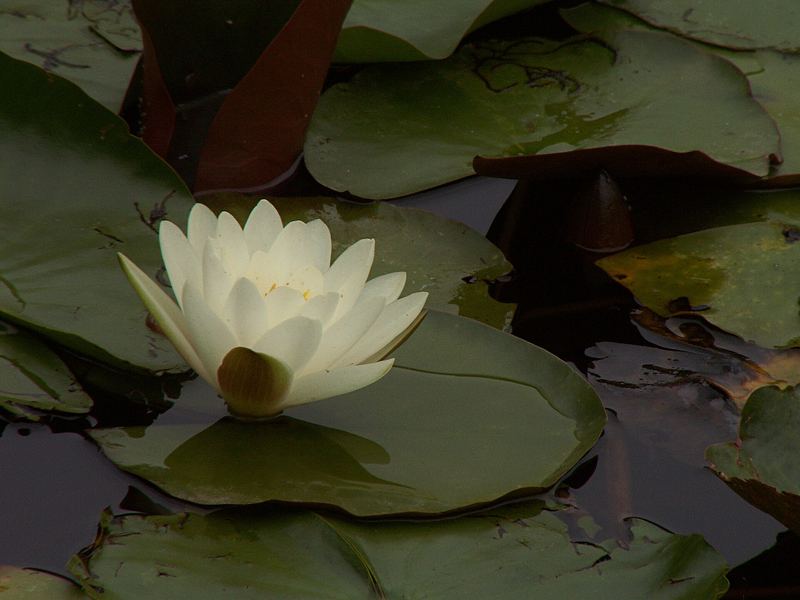
Pennsylvania's native water lily: round, leathery pads with a notch and large white flowers, usually in water less than about five feet deep.
Also called: fragrant water lily, American white waterlily

What it looks like
- Large, round, leathery floating leaves with a slit to the center.
- Large white flowers. PFBC notes water lilies can also be red or pink, but Penn State says the native species is white.
- Flexible stems rooted in the bottom, usually in water less than about five feet deep.
Easily confused with
- Spatterdock: heart-shaped leaves and yellow ball flowers.
- Watershield: smaller oval leaves with the stem attached at the center underneath.
- Yellow floating heart (invasive): much smaller leaves.
Good and bad for your pond
- Native, attractive and good fish cover.
- Can grow too thick in shallow water and choke docks, swimming and fishing areas.
Native or invasive?
Native
Native. Native (USDA PLANTS); Penn State notes the native species have large white flowers.
USDA PLANTS: NYOD (lower 48 states: native)
Do grass carp eat it?
Grass carp usually leave it alone
Grass carp usually don't control white water lily. Grass carp prefer submerged plants like pondweeds, elodea and coontail; they rarely control algae mats or lilies.
Checked Oct 4, 2026 · Source: Using Grass Carp to Control Aquatic Plants (updated May 19, 2025) This may be outdated
Control options
Prevention first
Penn State Extension's advice for every nuisance plant and algae problem starts with nutrients: overgrowth is a symptom of excess phosphorus and nitrogen from sources such as barnyards, crop fields, septic systems, lawns and golf courses. Cutting fertilizer near the pond, maintaining septic systems, diverting nutrient-rich runoff and keeping a vegetated buffer strip are the long-term fixes; without them, control becomes a yearly chore.
Checked Oct 4, 2026 · Source: Filamentous Algae (updated May 19, 2025) and the companion Penn State plant fact sheets This may be outdated
Remove it by hand or machine
Pull or cut small areas around docks and launches (PFBC). Penn State notes fountain aerators can help reduce lilies, which prefer still water.
Biological options
None effective.
Chemical options (permit first)
Penn State notes lilies can be treated later in summer than most plants. Any herbicide or algaecide in a pond needs a joint DEP/PFBC Chapter 91 permit first, at any amount. Only products registered with the U.S. Environmental Protection Agency and with the Pennsylvania Department of Agriculture, and labeled specifically for aquatic use, can be listed on the Chapter 91 permit application.
Checked Oct 4, 2026 · Sources: Water Quality Permitting for Pesticide Applications in Pennsylvania: FAQ (rev. Feb 21, 2025), FAQ #2, #3, #8, #10, #11, #28, #29; Permit Requirement for Use of an Aquatic Herbicide in Ponds (updated Sep 8, 2025) This may be outdated
Follow the product label; the label is the law. A Chapter 91 permit is required before any herbicide or algaecide goes in a pond (see fact). Consider a licensed applicator.
Sources
- Pond Management (Pennsylvania Fish and Boat Commission)
- Controlling Nuisance Aquatic Plants and Algae in Farm Ponds (Penn State Extension)
- Chemical Control of Aquatic Plants (Penn State Extension)
- USDA PLANTS Database (species profiles: https://plants.usda.gov/plant-profile/<SYMBOL>) (USDA Natural Resources Conservation Service)
Checked Oct 4, 2026